
Telltale - Preproduction
Introduction
Film sets are exciting because the cast and crew’s collective skill is applied to creating an impactful product. On-set Visual Effects supervision is exciting because it is an exercise in Murphy’s law. I want to be clear. The philosophy is not about a nihilistic outlook on wrongdoing. Rather, Murphy’s Law is a call to exceed despite countless opportunities for failure.
This is why I was thrilled to be approached to work on the senior thesis, Telltale. I will be collaborating with three skilled artists, Violetta Somov, Carolyn Kiszla, and Wren Pellant, to integrate a photorealistic beating heart in an actor’s hand in the senior thesis, Telltale. This blog will chronicle the steps that the team and I have/will take to achieve the director’s vision.
We were originally presented with two shots. The beating heart, and creating a crowd. Otherwise, we can do extraneous cleanup on other shots as long as it is reasonable. A huge thanks to Violetta, who brought me on to co-supervise with Carolyn on set.
The Crowd
The production needed a crowd in a dimly-lit room. There were not enough extras available to fill the audience. The team ruled out integrating CG characters because of the intense workload behind the effect. I am comfortable with cinematography on the greenscreen, so I proposed filming plates for compositing.
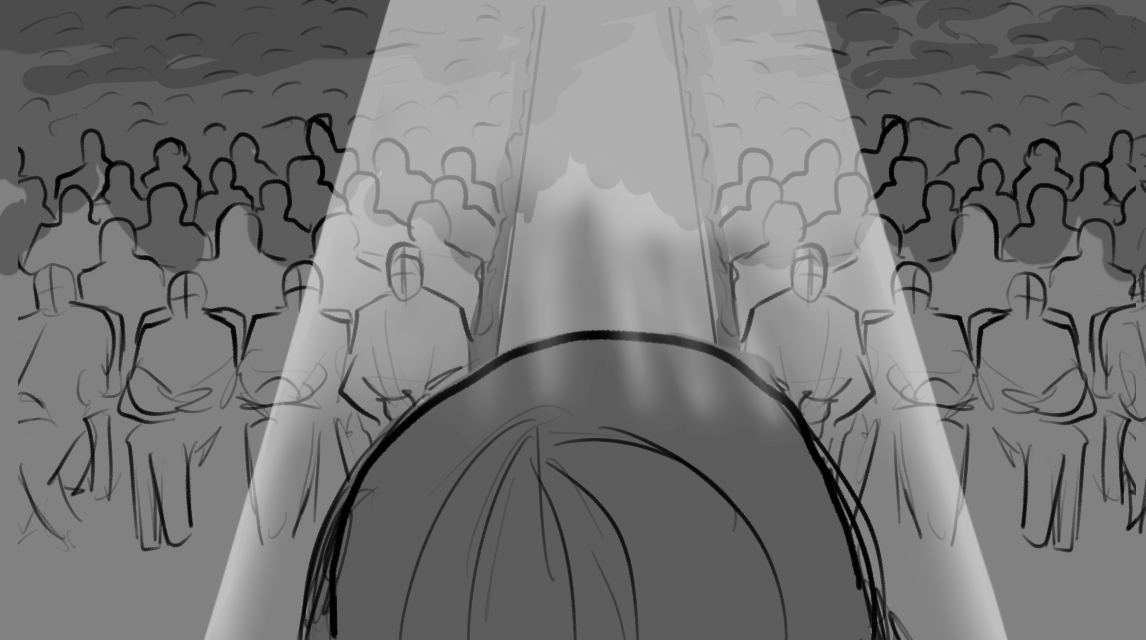
When the team was shown the picture of the location, it was clear that compositing greenscreen plates would harbor extreme room for error. The crowd would be in a dimly lit bar, with precise seat positions and complicated lighting captured from a high camera angle. Carolyn pivoted with a grand idea. We would do an extended “twin shot,” in which parts of the frame are spliced in order to use actors in frame multiple times. The team communicated this workflow to production, as well as the request for actors to have multiple sets of attire for their “twins.”
*Storyboard implied large audience from one angle.
Reflection
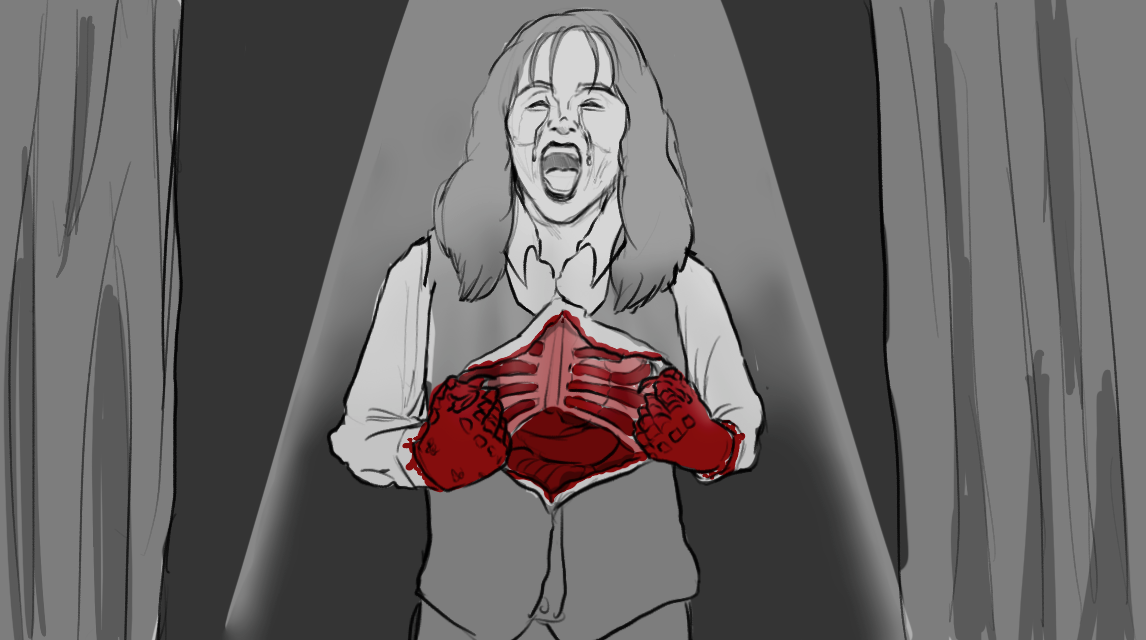
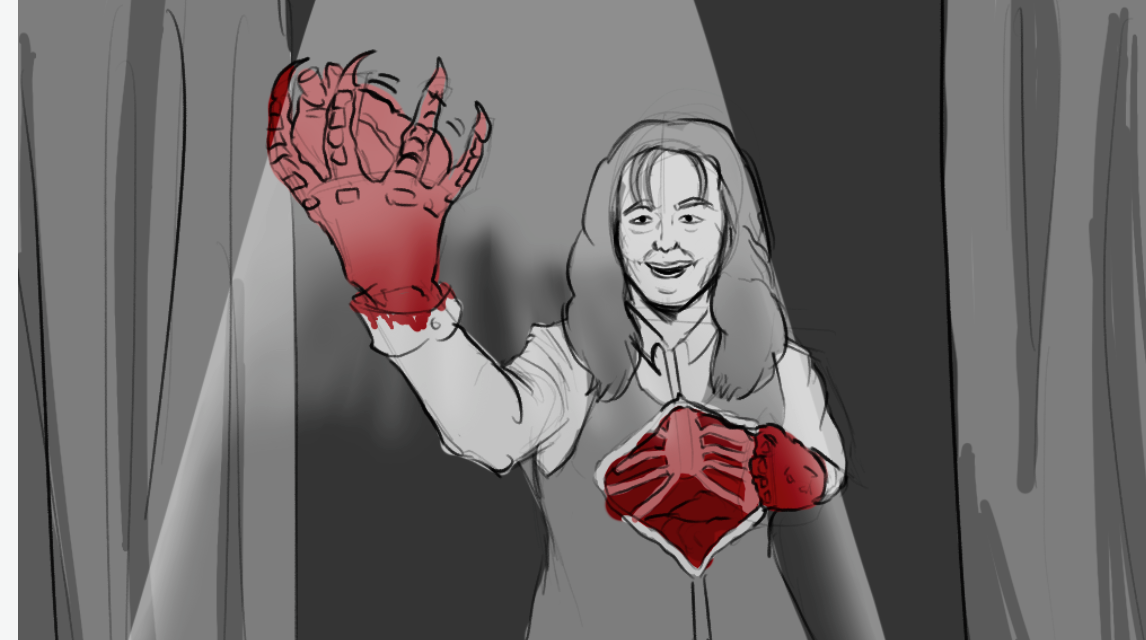
Carolyn’s instinct to veer practical affected how I looked at the heart shot. The shot consists of the actor tearing their heart out of the chest and presenting it palm-forward towards the camera. Critically, the heart is still beating.
It was clear that a purely digital workflow would introduce discrepancies of movement between the actor’s hand and the thumping heart. That’s when I proposed going practical. By having a moving object in place of the heart, the fingers would react believably.
Thankfully, we weren’t starting from scratch. The SFX team had six pig hearts and was willing to share two. The hard part was deciding what to put in them. There was not enough time to build a mechanical system. The debate was between moving air or liquid through the heart.
HEART
After a trip to Home Depot and an embarrassing excursion at CVS, we had our materials. The plan was to drive liquid from an external bladder through a hose to another bladder inside the heart. For the external bladder, we had an enema kit and a syringe on deck.
We also had two options for the hose. Latex hose has better flexibility, but is 1/2” and yellow. Vinyl tubing is clear, thinner, but stiffer. Though vinyl tubing would be easier to paint out, we used latex hose for ease of use.
We needed something hefty for the bladder that went in the heart. The windbag wedge sold at Home Depot was strong, but not malleable. I feared that a balloon would be too weak. We had condoms as a backup.
With liquid, we ran into problems with the hose. The small diameter held too much pressure and was difficult to simply fill. Therefore, the water did not rush back to the external bladder after squeezing. Then we tried air.
We swapped the enema for my bike pump. It inflates balloons inside the right ventricle with stellar performance. To let air out of the balloon at the end of the contraction, we slit a hole in the hose. Carolyn held a finger over the hole when I inflated, and let go when I reset the pump for inflating again.
Inflating one ventricle works. Then we tried inflating both by splitting the tube. The setup favored one ventricle over the other. We decided we wanted the system to be dependable on set, so we settled for the movement of one chamber.
DISSECTION
Then I dissected the heart. There were plenty of others, and I was curious. Before dissecting, I could not articulate the difference between the left atrium and the pulmonary veins. I felt like DaVinci or Szukalski.
Summary
In all, this process felt correct. I’ve learned of time-tested practical effects. It was fun to experiment with this process with those techniques in mind. In the end, the final shot will have some sort of digital manipulation.
Since the left ventricle does not move, we will have to tackle that in either 2D or 3D. We will do future tests to see which workflow fits. Also, the heart movement looks like a lung inflating. The goal was to receive realistic movement for film, not a physically accurate heart. In all, pre-production was a success.
The next post will be about the shoot. Stay tuned.